Insight details
Australian buyers often ask, "What does Australia import from China?" The practical answer is not only a product list. The better question is whether the product can move from a Chinese supplier to Australia with clear specifications, usable documents, correct import checks, and a shipment plan that will not fall apart after production.
China can be a good sourcing route for Australian buyers because many product groups are already exported at scale: consumer electronics, electrical parts, furniture, home and garden goods, apparel, bags, tools, toys, packaging, display items, and light industrial components. But every category has its own import questions. A toy, a timber item, a lithium battery product, and a stainless-steel component do not need the same supplier checks or Australian entry file.
Use the product category as the starting point, then check the supplier, quote, import rules, and shipment path before paying a deposit.
Start with the product group, not a broad market answer
Searches around what does Australia import from China usually mix two buyer needs. One buyer wants category ideas. Another already has a product and needs to know whether the order can be sourced, produced, inspected, and imported without surprises.
For sourcing work, broad category names are too loose. "Furniture" can mean flat-pack indoor furniture, upholstered items, metal shelving, bamboo products, outdoor sets, or custom hotel fixtures. "Electronics" can mean low-voltage accessories, chargers, LED products, Bluetooth devices, battery packs, or spare parts. Each version changes the supplier type, test documents, packaging, labeling, freight mode, and Australian import review.
Before collecting quotes, write the product in a way a supplier and broker can both understand:
| Product detail | Why it matters |
|---|---|
| Material and components | Supports supplier matching, HS code review, product safety checks, and biosecurity screening |
| Intended use | Helps separate consumer goods, industrial parts, food-contact items, children's goods, or regulated products |
| Quantity and packing | Affects MOQ, carton data, freight mode, warehouse work, and quote comparison |
| Destination in Australia | Helps the buyer plan customs broker handoff, delivery cost, and timing |
| Required documents | Shows whether the supplier can support compliance and import review |
A clear product description helps you compare China supplier quotes without turning the first week into a guessing exercise.
Check Australian entry rules before the supplier confirms too much
An Australia import from China should be checked from the destination side early. Australian government guidance points buyers to customs clearance, possible permits, duties, GST, product safety, labeling, and biosecurity questions. That means the supplier's willingness to sell is not enough.
Ask these questions before the order becomes hard to change:
- Is the item prohibited, restricted, or subject to an import permit?
- Does the product need product safety review before sale in Australia?
- Could the material create a biosecurity issue, such as timber, plant fiber, animal origin material, used goods, soil contamination, or untreated packing?
- Does the item need a country of origin marking or a trade description?
- Will the broker need a more specific invoice description than the supplier normally uses?
Do not ask the Chinese supplier to decide Australian admissibility. The importer and customs broker should confirm that. The supplier can still help by providing material details, product photos, certificates, test reports, packing data, and production records.
Treat ChAFTA as a document check, not an automatic saving
Some buyers importing from China to Australia ask whether the China-Australia Free Trade Agreement will reduce duty. That can be worth checking, but it should not be treated as a discount that applies to every order.
The buyer or broker needs to check the tariff classification, origin rules, and required proof of origin. The supplier may need to provide a certificate or declaration that matches the shipment and product. If the supplier cannot support the origin file, a lower quoted unit price may not lead to a lower landed cost.
For quote comparison, ask each supplier:
- Can you state the manufacturer and production location?
- Can you provide a commercial invoice and packing list with exact product descriptions?
- Can you support origin documents if the broker says they are needed?
- Will the invoice match the sample, carton labels, and final goods?
This is especially important for mixed orders, assembled products, outsourced components, and goods bought through traders.
Build the quote around GST, duty, freight, and local charges
The unit price is only one part of import costs from China to Australia. Australian import planning usually needs product value, freight, insurance where relevant, customs duty, GST, import processing charges, brokerage, destination handling, permits if required, and final delivery.
Ask Chinese suppliers to make the quote specific enough for a landed-cost review. A usable quote should show:
- Incoterm, such as EXW, FOB, CIF, or DAP
- port or pickup city in China
- carton quantity, size, gross weight, and net weight
- product material and model description
- sample cost and bulk unit price
- packing method and labels
- lead time and payment terms
- documents the supplier can provide
A cheap EXW quote from an inland city may become expensive after pickup, export handling, and forwarder coordination. A CIF or DAP quote may look convenient, but the buyer still needs to understand customs clearance, GST, and destination charges in Australia. Compare the total route, not only the supplier's line-item price.
Watch product safety, labels, and biosecurity before production
Australia has strict controls for some goods. That does not mean every order is difficult. It means the buyer should separate ordinary supplier checking from destination market checking.
For example, children's products may need safety review and age-grade thinking. Electrical goods may need test reports, plug details, ratings, instructions, and packaging labels that match the Australian sale plan. Timber, bamboo, rattan, seeds, plant-based decorations, food-contact goods, and some natural materials may raise biosecurity or labeling questions. Cosmetics, chemicals, and cleaning products may involve another layer of registration or ingredient review.
The sourcing mistake is to ask for the lowest quote first and ask about compliance later. A better order of work is:
- define the product and target use;
- ask the broker or local adviser what documents are needed;
- screen suppliers for document readiness;
- approve the sample against both product and packaging requirements;
- confirm carton labels and shipping marks before mass production ends.
This order does not remove all risk, but it gives the buyer more time to fix issues before goods are packed.
Plan the China-to-Australia shipment file early
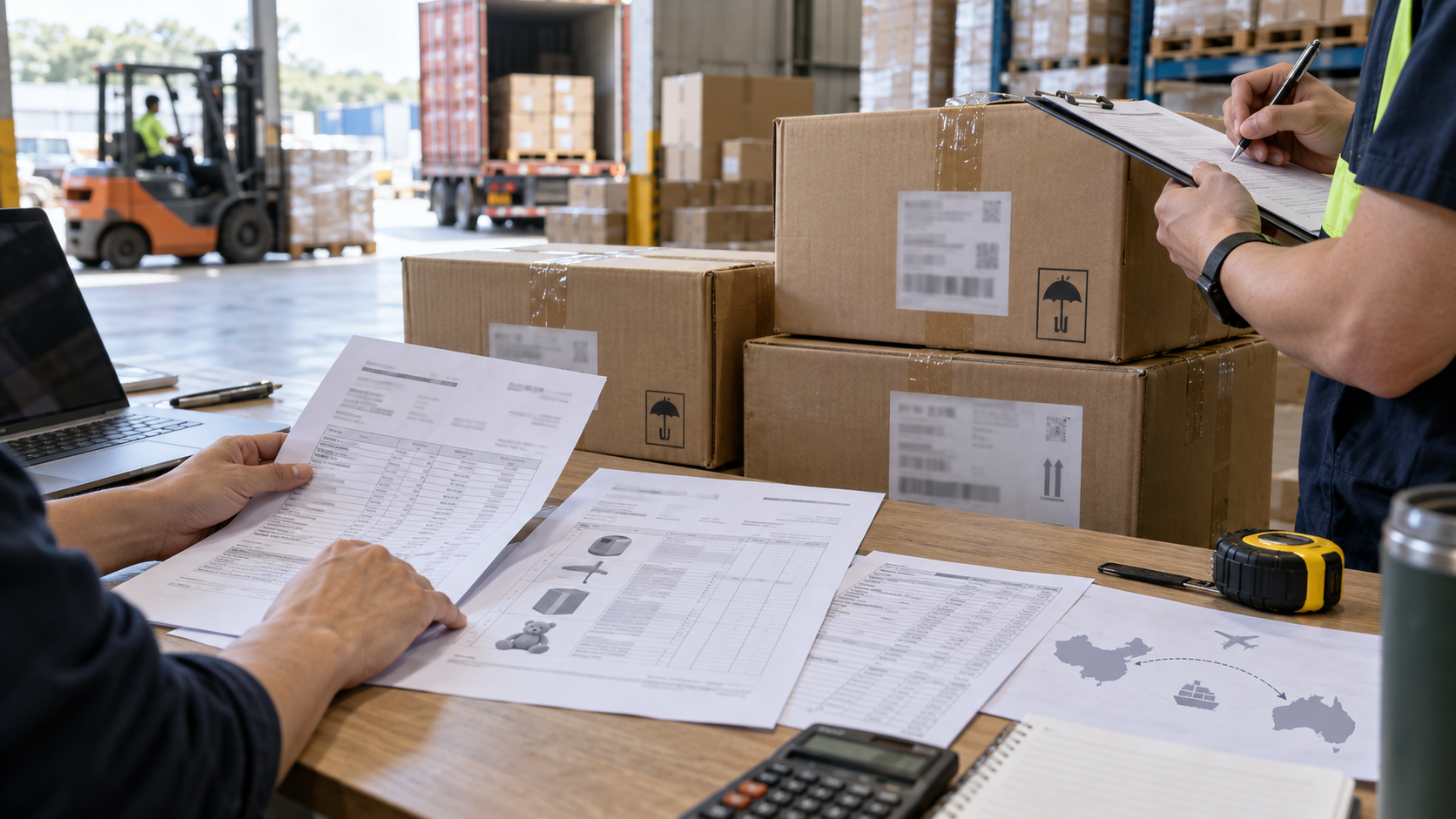
Shipping from China to Australia often looks simple when the supplier says, "We can ship." The details still matter. A small courier shipment, LCL sea freight, FCL container, and air shipment need different data and timing.
Before production finishes, prepare a shipment file with:
- supplier name and pickup address;
- consignee and importer details;
- product description for invoice and broker review;
- packing list with carton count, size, weight, and marks;
- final photos of goods, cartons, and labels;
- inspection status or sample approval record;
- freight term and forwarder contact;
- any permit, test report, or origin document requested by the broker.
If goods come from more than one Chinese supplier, add a warehouse receiving plan. Mixed orders need clean receiving records, carton checks, repacking decisions, and one packing list that matches the final shipment. This is where many small Australia-bound orders become messy: every supplier sends a different label, carton format, and invoice wording.
Where China-side follow-up helps
Alex Trading Group does not replace the Australian importer or customs broker. The buyer still needs destination-side advice for classification, duty, GST, permits, and final clearance. The China-side work is different: make the supplier information usable before the broker sees it.
That can include supplier search, supplier review, quotation cleanup, sample coordination, packing checks, inspection timing, warehouse receiving, consolidation, and shipment handoff. For Australian buyers comparing suppliers, factory-direct sourcing support can help turn vague supplier replies into a clearer decision file.
This matters when the product has several material options, the supplier is a trader, the quote does not name the Incoterm, the packaging is custom, the order uses multiple suppliers, or the buyer needs documents before approving production.
What to send before sourcing for Australia
If you are planning to import from China to Australia, send enough detail for the sourcing and import questions to be checked together:
- product photos, drawings, or reference links;
- target quantity and expected order pattern;
- material, size, color, function, and packaging requirements;
- destination city or warehouse in Australia;
- current supplier quotes if you already have them;
- any broker notes, permit concerns, test requirements, or product safety questions;
- preferred freight mode or deadline.
The goal is not to make the first message perfect. The goal is to avoid sourcing a product that later fails on documents, packaging, labeling, or shipment readiness.
If you need China-side support for an Australia-bound order, you can contact Alex Trading Group with your product details, supplier links, and current questions. We can help review the sourcing side, organize supplier follow-up, and prepare the China-side information your broker or forwarder will need.