Insight details
If your team still treats an under-$800 sample from China as a low-friction shipment, that assumption may already be wrong. Small parcel imports now deserve the same planning discipline as a larger order, especially if the shipment is moving by courier under DAP terms or includes product categories that already carry extra duties. Buyers who need a broader first-order process can also review our China import workflow.
What changed, with dates
The U.S. policy moved in stages. On April 2, 2025, the White House announced the end of duty-free de minimis treatment for products from China and Hong Kong. That change took effect on May 2, 2025. Then the White House suspended de minimis treatment for commercial shipments from all countries effective August 29, 2025. On February 20, 2026, that suspension was continued. A June 3, 2026 White House customs enforcement fact sheet also signaled tighter review, including more use of formal entry, importer verification, and bond requirements where Customs decides informal treatment is not enough.
For buyers, the practical point is simple: the old shortcut is gone. A low unit value does not automatically mean a light customs process.
Which shipments usually get caught
This change matters most when buyers move:
- development samples before bulk approval
- replacement parts or urgent top-up cartons
- mixed cartons from several suppliers
- small pilot orders sent by express courier
- DAP offers where the supplier quotes "delivered" without showing the customs method underneath
These shipments often move fast, and speed is exactly why teams skip the review. The result is familiar. The supplier gives a DAP or courier price. The buyer compares only the freight number. Nobody confirms the HS code, the importer of record, the extra duty exposure, or whether the carrier will request more paperwork after departure. The shipment leaves. Then the landed cost changes.
Recheck the quote line by line
When a supplier or forwarder quotes a small shipment, ask for the quote in parts instead of one final number.
Confirm:
- product value
- freight charge
- trade term
- declared HS code
- country of origin
- estimated duty and tax
- customs clearance or brokerage fee
- who acts as importer of record
- whether a bond or additional customs filing may be needed
A $260 sample and a $180 courier charge can still turn into a very different landed cost once duty, carrier clearance, or a more formal customs process gets added.
This matters even when the shipment is only a sample. A sample still needs a usable product description, a reasonable declared value, and a customs route that matches the goods. If the supplier writes "sample" on the invoice but the parcel contains saleable goods, mixed materials, batteries, branded packaging, or multiple SKUs, the label alone will not solve the entry issue.
This is also where existing quote review habits break down. Buyers who already read FOB, EXW, CIF, or DAP quotations carefully can still miss the customs side of a small parcel. The freight term explains responsibility. It does not remove the need to check the duty path.
Do not approve the sample and the shipment route separately
A sample approval decision and a shipping decision should stay connected.
Before the sample leaves China, confirm:
- whether the sample represents final production material and finish
- whether the invoice description matches the actual item
- whether the declared quantity, unit value, and purpose are reasonable
- whether the supplier used the same product classification logic that will later be used for bulk orders
- whether any testing, labeling, battery, textile, food-contact, or child-product issue changes the customs risk
If the sample moves smoothly only because the paperwork was vague, that does not help later. It creates a false sense of security. A clean sample shipment should teach you how the bulk order will be documented, not hide the problem until production is finished.
Decide who the importer of record is before goods leave
Many small-shipment problems come from this one gap. The buyer assumes the courier will handle everything. The supplier assumes the buyer has a U.S. importer setup. The forwarder waits until the parcel is already in transit.
Settle these questions early:
- Is the buyer acting as importer of record?
- Is a customs broker involved?
- If the supplier says DAP, what exactly is included and excluded?
- If Customs upgrades the shipment or asks for more proof, who will answer?
- Is there a continuous bond or other standing import setup that can support recurring small shipments?
For repeat sample programs, spare-part flows, or frequent top-up cartons, this matters even more. The process should be repeatable. If every shipment depends on last-minute email clarification, the delay risk stays with you.
Keep the paperwork short but complete
You do not need bloated paperwork. You do need clear paperwork.
At minimum, most buyers should expect to review:
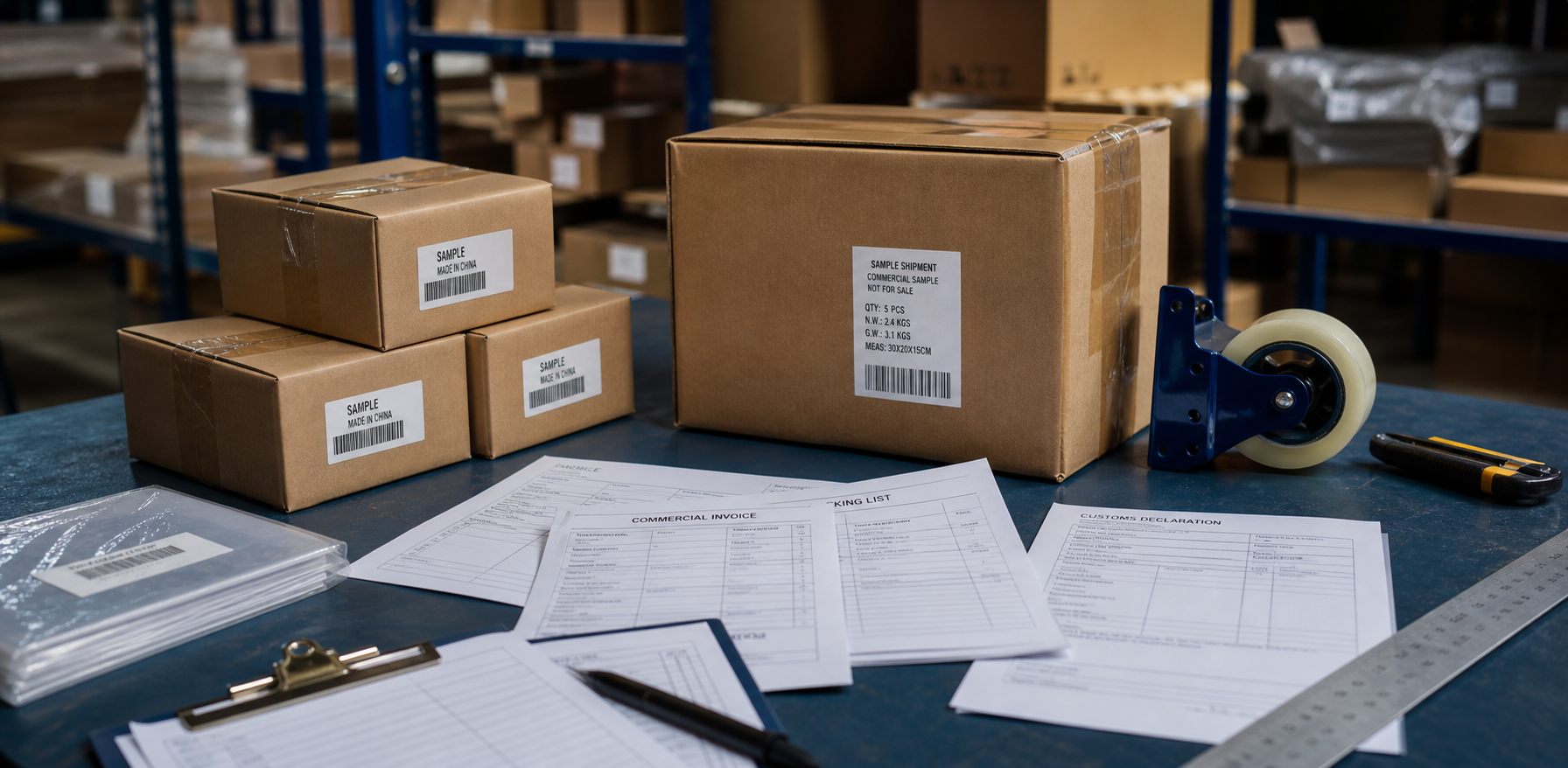
- commercial invoice
- packing list
- product description that matches the goods
- HS code used for the quote
- origin statement
- consignee and importer details
- any product-specific documents the carrier or broker may request
Ask the supplier to send the draft invoice and packing details before dispatch, not after pickup. That gives you time to catch vague wording like "accessories," "parts," or "gift sample," which often creates more questions than answers.
Where China-side follow-up helps
This is usually not a sourcing problem in the narrow sense. It is an execution problem. The supplier, the sample, the courier quote, and the customs paperwork need to line up.
That is where trade execution support becomes useful. The work is often simple but time-sensitive: checking the quote scope, confirming what the supplier will declare, matching the invoice to the actual sample, and making sure the handoff between supplier, courier, and buyer is not based on guesswork.
For mixed-supplier shipments or top-up cartons that need receiving and regrouping before export, buyers may also need warehouse-side coordination before the parcel ever reaches the international leg.
What to send before you ship
If you want a fast review of a sample or small-order shipment, send:
- product photo or specification
- supplier quotation
- draft invoice or shipping description
- proposed trade term
- destination in the United States
- planned carrier or forwarder
- target ship date
- whether this is a sample, replacement, pilot order, or urgent top-up
That is usually enough for a first check. You do not need a finished procurement pack to catch most of the avoidable problems.
The main mistake is waiting until the courier asks for more documents. By then, the shipment is already in motion and your options narrow. If you want another set of eyes on the quote, sample paperwork, or shipping setup, send your shipment details here.