Insight details
Sourcing custom fashion jewelry from China starts with a simple discipline: make every supplier quote the same product.
That sounds obvious, but a photo of a necklace does not show its base metal, plating method, chain construction, clasp, stone type, weight, packaging, or test requirements. If those details are left open, two suppliers can offer very different prices and both can claim to be quoting the requested design.
Consider an order for about 1,000 custom necklaces. That quantity might be one design in one finish, or ten designs split across several colors. It might use a standard chain and an existing pendant mold, or require a new mold, logo, stones, and retail packaging. Each version has a different MOQ, sampling process, cost, and production risk.
This guide shows how to turn a jewelry idea into a usable RFQ, compare Chinese suppliers on equal terms, approve a sample, and keep the approved details visible during bulk production.
What Should a Custom Fashion Jewelry RFQ Include?
A useful RFQ gives the supplier enough information to price the product without filling important gaps with assumptions. It does not need to be a complex technical document, but it should define the details that affect appearance, function, cost, and compliance.
For a necklace, include:
- reference photos, drawings, or a physical sample;
- pendant length, width, thickness, and target weight;
- chain type, width, total length, and extension length;
- clasp type and size;
- base material for the pendant, chain, clasp, and connecting parts;
- plating or coating method, color, finish, and required thickness where applicable;
- stone, pearl, enamel, or other decorative details;
- logo position and application method;
- quantity by design, color, and size;
- individual packaging, labels, barcodes, and carton requirements;
- destination country and any required testing or documents;
- requested sample time, production time, and trade term.
If you do not know a specification, identify it as an open question. A supplier can then recommend its normal option and quote alternatives separately. This is much safer than allowing an unknown requirement to become an undocumented substitution.
Buyers preparing a multi-product inquiry can also use the broader checklist in how to prepare an RFQ for Chinese suppliers.
Turn the Reference Photo into a Product Specification
Reference photos are useful for discussing style, but they are weak production standards. Lighting changes metal color, scale is hard to judge, and internal construction is invisible.
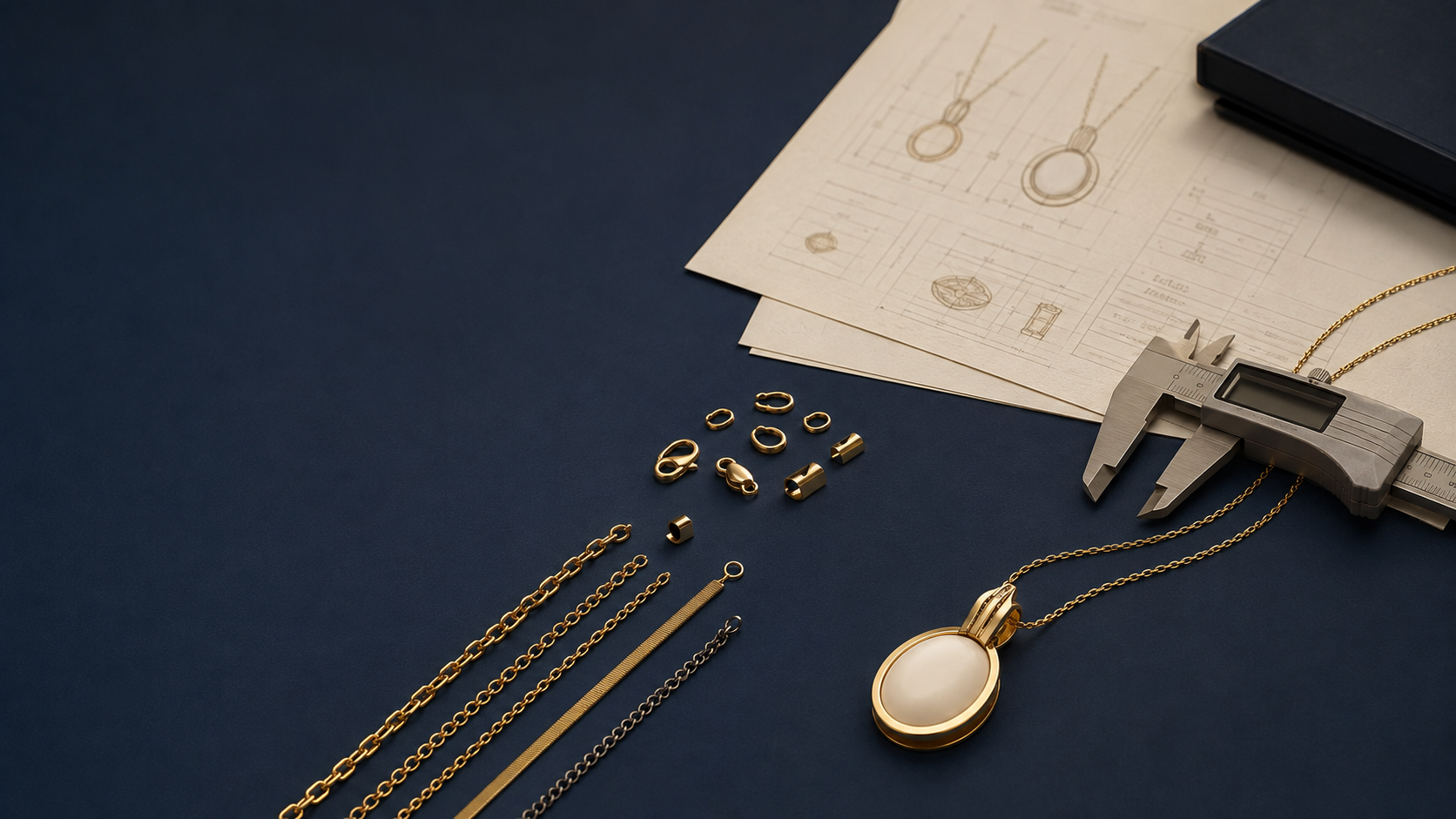
Break the product into components before requesting a final price. A custom necklace may contain a pendant, chain, jump rings, clasp, extension chain, logo tag, stones, and packaging. These parts do not necessarily use the same material or finishing process.
A simple specification table helps expose missing information:
| Item | What to define |
|---|---|
| Pendant | Material, dimensions, thickness, weight, shape and surface finish |
| Chain | Material, chain style, width, length and extension length |
| Clasp and findings | Material, clasp type, size, color and connection method |
| Plating or coating | Method, color reference, finish, thickness and protective layer where applicable |
| Stones or decorative parts | Material, size, color, quantity, setting or attachment method |
| Branding | Logo artwork, position, size, engraving, stamping or tag method |
| Packaging | Bag, card, pouch or box, printing, labels, barcode and carton packing |
This table also makes supplier responses easier to compare. If one supplier leaves the chain material blank while another specifies it, the missing answer is visible before a deposit is paid.
Choose Materials by Component, Not by a Broad Product Label
Terms such as “alloy jewelry,” “stainless steel necklace,” and “gold-plated pendant” are not complete material specifications.
Common base materials for fashion jewelry include stainless steel, brass, zinc alloy, silver, and mixed constructions. The right choice depends on the design, finishing method, target price, expected use, weight, product claim, and destination market. There is no single material that is automatically best for every fashion jewelry order.
Ask the supplier to identify the material used in each important component. The pendant may be brass while the chain is stainless steel; the clasp or earring post may use another metal. If a supplier proposes a cheaper alternative, keep it as a separate quotation rather than silently replacing the requested construction.
Be careful with descriptions such as “premium alloy,” “real gold finish,” or “high-quality stainless steel.” These phrases sound reassuring but do not provide a measurable purchasing standard. Where the material grade or composition matters, record it in the RFQ and purchase specification and decide what supporting documents or testing are required.
Define Plating, Color, and Finish Before Comparing Prices
“Gold plated” can describe products with very different construction and wear performance. The result depends on the base material, surface preparation, plating or coating process, color, thickness, undercoat, protective layer, product use, and care conditions.
Ask each supplier to state:
- the plating or coating method;
- the proposed color and reference used;
- thickness in a measurable unit where applicable;
- any undercoat or protective topcoat;
- polished, matte, brushed, antique, or other finish;
- whether every metal component receives the same process;
- the available durability or surface tests and their test conditions.
Do not use a color name as the only approval standard. “18K gold color,” for example, can vary between suppliers and production batches. A physical approved sample or an agreed color reference gives both sides a clearer comparison point than a phone photo.
Avoid requesting promises such as “never fades” or “never tarnishes.” No short phrase can replace a defined construction, appropriate testing, realistic product claims, and clear care conditions.
Specify Stones, Pearls, Enamel, and Small Parts
Small decorative parts often explain a large price difference.
For stones, state whether the requirement is natural, laboratory-grown, synthetic, glass, acrylic, resin, cubic zirconia, or another material. Include the size, shape, color, quantity, and setting method. For pearl-style products, clarify whether the design uses natural pearls, cultured pearls, shell pearls, glass pearls, plastic pearls, or another imitation material.
Then look at the less visible components. Earring posts and backs, jump rings, clasps, extension chains, soldered joints, glue, and stone settings can affect both appearance and function. Useful sample checks include:
- secure clasps and connections;
- smooth edges without sharp burrs;
- even stone placement;
- limited visible glue;
- consistent enamel fill;
- left-right matching for pairs;
- correct movement in hinged or articulated parts.
These checks are more useful than a general instruction to “make good quality.”
Explain the Quantity Breakdown, Not Only the Total
MOQ is usually affected by the way an order is divided. An inquiry for 1,000 pieces may look attractive until the supplier learns that it covers ten designs, two plating colors, and several sizes.
State the quantity per design, color, size, and packaging version. Ask whether the supplier calculates MOQ by:
- design or mold;
- plating color;
- stone or enamel color;
- size;
- custom component;
- packaging type.
There is no reliable universal MOQ for custom jewelry. It depends on the product and the supplier’s process. An unusually low MOQ may mean the supplier is using an existing mold, standard components, available materials, or a different production arrangement. That may be acceptable, but it should be clear in the quotation.
If the normal MOQ is too high, discuss specific trade-offs: fewer color variations, an existing chain or clasp, standard packaging, or an existing mold. Each option changes the product, so record the agreed version before sampling.
Separate One-Time Costs from the Unit Price
A useful jewelry quotation should show more than one number. Ask suppliers to separate:
- unit price at the requested quantity;
- sample cost;
- mold, tooling, artwork, or setup charges;
- logo and custom component costs;
- packaging and labeling costs;
- testing or inspection costs where applicable;
- delivery or China-side logistics included in the quote.
Also confirm who owns a paid mold, how long it will be kept, whether it can be reused for repeat orders, and which design changes would require new tooling.
This prevents a low unit price from hiding excluded setup costs. It also helps a buyer understand the economics of a repeat order after the initial development work has been completed.
Use Samples as an Approval Record
A sample is not only a product to look at. It is the bridge between the RFQ and bulk production.
Before approval, check the sample against the written specification:
- dimensions, thickness, and weight;
- material and component construction;
- plating color and finish;
- chain length, clasp operation, and connections;
- logo size, position, and legibility;
- stone placement, color, and setting;
- symmetry and pair matching;
- polishing, edges, soldering, and visible marks;
- packaging fit and label accuracy;
- agreed tests or documents.
Ask whether the sample uses the intended bulk-production materials and process. An early development sample may use a temporary mold, available chain, substitute stone, or hand-finished detail. That can be useful for checking the design, but it should not be mistaken for the final production standard.
Record the approved version with dated photos, measurements, artwork, packaging files, and written approval notes. If one detail changes, update the specification as well as the sample comments. Otherwise, the buyer and factory may enter production with different “final” versions.
The next control point is explained in what to check before approving a sample for bulk production.
Compare Suppliers on the Same Table
Supplier discovery and supplier selection are different jobs. Alibaba, 1688, Made-in-China, Global Sources, trade fairs, and local networks can all produce candidates. Buyers comparing those channels can review Alibaba alternatives for China sourcing.
Once quotations arrive, place them in one controlled table:
| Comparison item | Supplier A | Supplier B | Supplier C |
|---|---|---|---|
| Material by component | |||
| Dimensions and target weight | |||
| Plating method, color, and thickness | |||
| Stones or decorative parts | |||
| MOQ by design and color | |||
| Unit price | |||
| Sample and tooling costs | |||
| Packaging included | |||
| Testing or documents included | |||
| Sample and bulk lead time | |||
| Payment terms | |||
| Incoterm and named place | |||
| Exclusions and open questions |
Do not fill blank cells with assumptions. Send the missing question back to the supplier. If the product specification changes, update the table so the price remains connected to the correct version.
Price still matters, but only after the offers are made comparable. The wider review process is covered in how to compare Chinese supplier quotations beyond price.
Check Whether the Supplier Can Repeat the Approved Result
A polished sample does not prove that the same result can be repeated across a bulk order.
Look at how the supplier handles information. Does it answer material questions clearly? Does it record revisions? Can it explain which work is done internally and which steps, such as plating or stone setting, are subcontracted? How will components and finished goods be checked? Will the supplier accept an agreed pre-shipment inspection?
Subcontracting is not automatically a problem in a specialized supply chain. The important point is whether responsibilities, standards, and change control remain visible.
Warning signs include unexplained substitutions, inconsistent company or payment details, a price that cannot be tied to a specification, repeated avoidance of testing questions, unclear mold ownership, and pressure for payment before the sample and order terms are confirmed.
Plan Compliance and Inspection Around the Destination Market
Jewelry requirements can vary by destination, product material, intended age group, skin contact, labeling, and the claims used to sell the item. A supplier’s statement that a product is “international standard” is not enough to define what must be tested.
Before ordering, identify the actual market and sales-channel requirements. Depending on the product, the buyer may need to address restricted substances such as lead, cadmium, or nickel; children’s product rules; precious-metal or plating descriptions; traceability; country-of-origin marking; or retailer-specific documentation.
Tell the supplier the destination country, intended customer, applicable test or requirement, sample selection method, and required report format. Where compliance is important, confirm the test plan with a qualified laboratory or compliance professional. Do not assume that an old report for a similar product automatically covers a new material, color, component, or production batch.
Inspection should also use product-specific criteria. For fashion jewelry, that may include quantity, assortment, dimensions, weight, color and finish, stone setting, clasp function, logo, pair matching, surface defects, packaging, labels, and carton information. The approved sample and final specification should be available to whoever performs the inspection.
Keep the Final Specification Active During Production
Before bulk production starts, collect the final specification, approved sample record, artwork, packaging files, quantity breakdown, price, payment terms, lead time, inspection criteria, and delivery terms in one order file.
Clarify when the quoted lead time begins. It may start after the deposit, final artwork, material confirmation, or sample approval rather than on the day the first inquiry was sent.
During production, follow the milestones that matter to the order: tooling, pre-production confirmation, material or component preparation, plating color, packaging approval, expected completion, inspection timing, and final carton details.
If the supplier proposes a change, ask what is changing, why it is needed, and how it affects appearance, performance, price, and schedule. Approve the revised version in writing before it enters bulk production.
When China-Side Sourcing Support Helps
China-side support can be useful when a buyer has product photos or a design but needs help turning them into one supplier brief, collecting comparable quotations, coordinating samples, following production, arranging inspection support, or receiving goods before consolidation and shipment.
Alex Trading Group can support these coordination steps according to the requirements and supplier situation of each project. This support does not replace the buyer’s product decisions, compliance responsibilities, or final supplier approval. Its practical purpose is to keep specifications, supplier responses, samples, and production status visible before shipment.
For an initial review, buyers can send:
- product photos, drawings, or reference links;
- quantity by design and color;
- known materials and dimensions;
- destination country;
- target packaging;
- existing supplier quotations or sample feedback;
- required testing or documents;
- target schedule and shipment plan.
FAQ
Can I ask a Chinese jewelry supplier for a quotation using only a photo?
Yes, a photo can start the discussion, but it is rarely enough for a final comparable quotation. Ask the supplier to confirm dimensions, weight, material by component, chain and clasp details, plating, stones, logo, packaging, MOQ, and every assumption used in the price.
Which material is best for custom fashion jewelry?
There is no single best material for every design. Compare materials against the product’s construction, appearance, target price, expected use, finishing process, product claims, and destination-market requirements. Request alternatives as separate options rather than mixing them in one quotation.
Why are quotations for the same necklace so different?
The suppliers may not be quoting the same necklace. Differences in base metal, weight, plating, chain, stones, mold costs, packaging, MOQ, testing, and delivery terms can all change the price. A controlled comparison table shows whether the price gap remains after those details are aligned.
How should I compare artificial jewelry suppliers in China?
Use the same RFQ and sample criteria for every supplier. Compare materials, plating, dimensions, sample result, MOQ, tooling, packaging, testing, lead time, payment terms, communication, change control, and inspection access—not only the unit-price column.
What should I approve before custom jewelry enters bulk production?
Approve the final material and component specification, dimensions, weight, plating color and finish, stones, logo, packaging, quantity breakdown, artwork, sample record, inspection criteria, lead time, and commercial terms. Any temporary material or process used in an early sample should be resolved first.
Can a sourcing partner guarantee jewelry quality or compliance?
No. China-side support can coordinate supplier communication, samples, production follow-up, and inspection arrangements, but it cannot replace a clear specification, appropriate testing, inspection, supplier execution, or the buyer’s compliance decisions.
Final Takeaway
The strongest custom jewelry inquiry is not the one with the longest message. It is the one that removes the assumptions most likely to change the product or price.
Define the construction, material, plating, dimensions, decorative parts, branding, packaging, quantity breakdown, testing needs, and delivery basis. Use the sample as a recorded approval standard, compare suppliers on the same table, and keep the final version active during production.
That process will not remove every sourcing risk. It will make quotations easier to compare, changes easier to control, and problems easier to identify before the goods are shipped.