Insight details
When you compare Chinese supplier quotations, the first number on the page can be misleading.
One supplier may quote EXW. Another may quote FOB. A third may offer CIF or DAP. The unit price looks different, but the reason may have little to do with the product itself. It may come from who pays for local pickup, port delivery, export handling, freight, insurance, documents, or delivery after arrival.
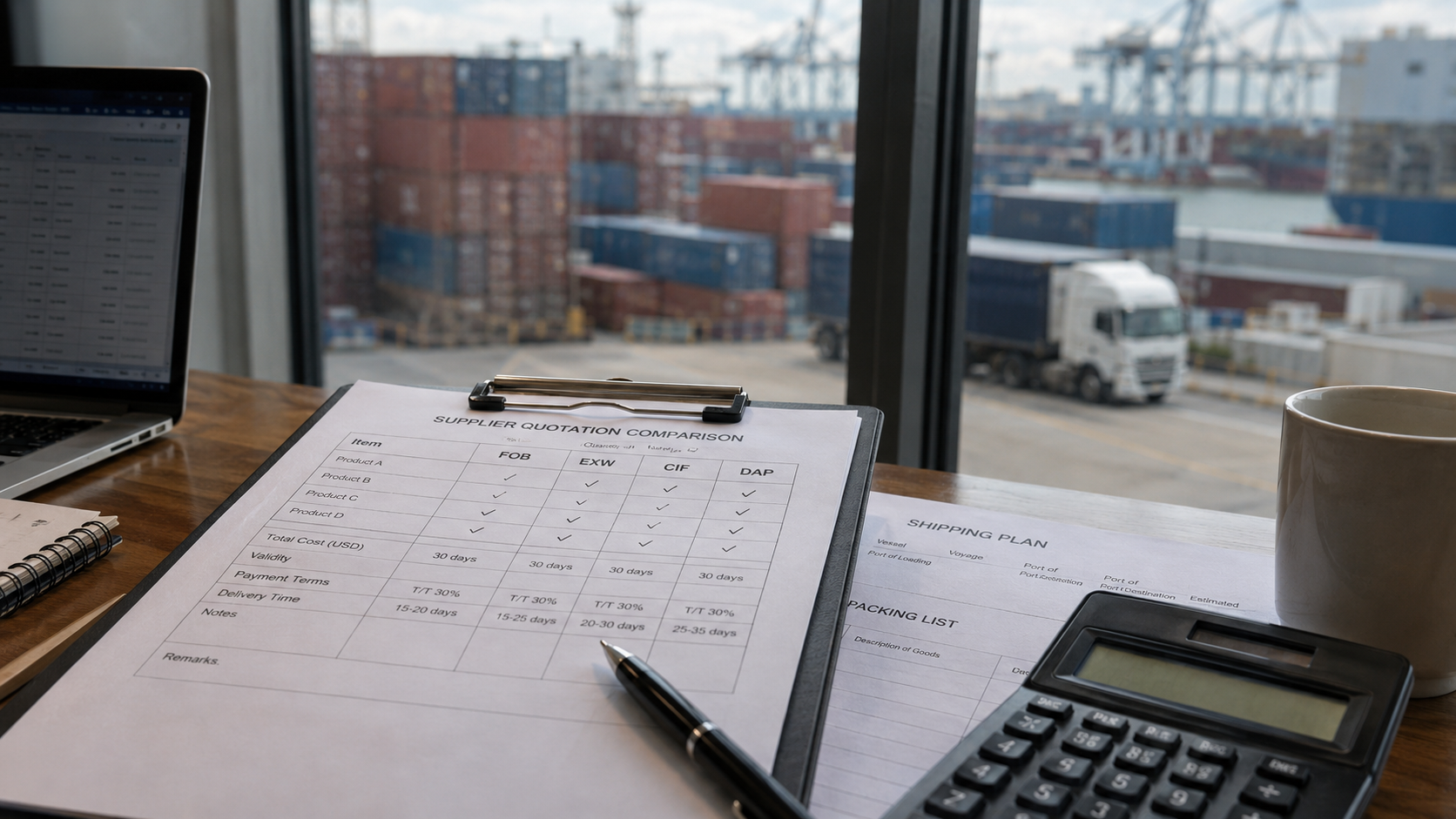
FOB, EXW, CIF, and DAP mainly differ in how transport responsibilities, shipping costs, and handoff points are divided between the supplier and buyer. EXW leaves more China-side coordination to the buyer, FOB usually includes delivery and export handling to the named port, CIF adds freight and insurance to the destination port, and DAP moves delivery closer to the buyer's named destination while import clearance and duties still need clarification.
| Term | Supplier typically handles | Buyer still needs to clarify |
|---|---|---|
| EXW | Goods available at the named factory or place | Pickup, export handling, freight, import clearance, final delivery |
| FOB | Export clearance and delivery on board the vessel at the named port | International freight, insurance if needed, import clearance, destination delivery |
| CIF | Cost, insurance, and freight to the named destination port | Destination charges, import clearance, duties, taxes, inland delivery |
| DAP | Delivery to the named destination, ready for unloading | Import clearance, duties, taxes, unloading, and any excluded destination costs |
Before choosing the cheaper supplier, check the trade term behind the quote. Otherwise, you may compare several different offers as if they were the same thing.
For a broader quotation comparison process, see our guide on how to compare Chinese supplier quotations beyond price.
Why the trade term changes the real cost
A supplier quotation is not just a product price. It also shows where the supplier's responsibility ends.
The trade term can affect who arranges factory pickup, who pays for local delivery, who handles export customs, who books freight, who prepares documents, and where risk moves from seller to buyer.
That is why an EXW quote often looks cheaper than an FOB quote. The supplier is leaving more work for the buyer. A CIF quote may look more complete because freight is included, but destination charges, import clearance, duties, taxes, and local delivery may still be outside the price.
A clean comparison starts with one question:
What exactly is included?
EXW: when the buyer takes over early
EXW usually means the supplier makes the goods available at its factory, warehouse, or another named place. After that, the buyer needs to arrange pickup, export handling, shipping, import clearance, and final delivery.
This can work if you already have a forwarder or team in China. It becomes harder when you are managing the order from overseas and have no one to check the goods, confirm carton quantity, arrange pickup, or connect the shipment with export procedures.
Before accepting EXW, ask:
- Where exactly will the goods be available?
- Are the goods packed for export?
- Can the supplier provide carton dimensions and gross weight?
- Who will arrange pickup from the factory?
- Can the goods be sent to a warehouse for checking or consolidation?
- Who will handle export declaration?
EXW is not wrong. It just leaves more coordination on the buyer's side.
FOB: often easier for sea shipments
FOB is common in China export quotations, especially for sea freight. You may see terms such as FOB Shanghai, FOB Ningbo, FOB Shenzhen, or FOB Guangzhou.
With FOB, the supplier usually handles local delivery and export preparation up to the named port. The buyer then arranges international freight, insurance if needed, import clearance, and delivery after arrival.
FOB is often easier than EXW for overseas buyers because more of the China-side work is included. Still, the details need checking.
Ask the supplier:
- Which port is named in the quote?
- Does the price include delivery to that port?
- Is export customs handling included?
- Are local port charges included or separate?
- Can the supplier provide a commercial invoice and packing list?
- When will the goods be ready?
- Who will contact the buyer's forwarder?
Do not assume every FOB quote includes the same local costs. Suppliers and forwarders may handle details differently.
CIF: convenient, but not complete
CIF means the supplier includes cost, insurance, and freight to the named destination port.
This can be convenient when the buyer wants the supplier to arrange shipping. The problem is that CIF does not mean the goods are delivered to your warehouse. After the cargo arrives, the buyer still needs to handle destination charges, import clearance, duties, taxes, unloading, and inland transport.
There is another issue. If the supplier controls the freight arrangement, the buyer may have less visibility over carrier choice, sailing schedule, destination fees, and how problems are handled after arrival.
Before accepting CIF, ask:
- Which destination port is named?
- What shipping route is being used?
- What insurance is included?
- Are destination charges excluded?
- Who provides the bill of lading?
- Can you use your own forwarder instead?
- What happens if freight rates change before shipment?
CIF is useful in some cases. It is risky when the buyer only sees "freight included" and stops asking questions.
DAP: closer to delivery, but customs still matters
DAP means the seller arranges delivery to a named place. That place might be a port, warehouse, business address, or project site.
DAP can reduce work for the buyer, but it does not automatically include import customs clearance, duties, taxes, or every destination-side cost. These points need to be written clearly.
Ask:
- What exact destination is named?
- Does the quote include inland delivery after arrival?
- Who handles import clearance?
- Are duties and taxes excluded?
- What documents does the destination country require?
- Who is responsible if customs clearance is delayed?
DAP can be practical when the delivery route is clear. It becomes messy when the quote only says "delivered" without explaining what happens at customs.
Why the cheapest quote may not be cheaper
A lower unit price may simply mean the supplier has included fewer responsibilities.
A quotation review should also be combined with supplier verification. Before paying a deposit, buyers should confirm supplier identity, production ability, and order details. See our guide on how to check a Chinese supplier before paying a deposit.
Before comparing suppliers, put their quotes into the same structure:
- Unit price
- Trade term
- Named port or place
- Packaging
- Local delivery
- Export handling
- Freight
- Insurance
- Shipment documents
- Inspection timing
- Warehouse or consolidation needs
- Destination-side costs
An EXW quote from one supplier and an FOB quote from another supplier are not equal. The EXW supplier may still require extra cost for pickup, warehouse handling, export documents, and port delivery. The FOB supplier may look more expensive because some of that work is already included.
The real question is not "Which price is lower?"
The better question is: "After all missing costs are added, which offer is clearer and easier to execute?"
Ask about the HS code early
Trade terms are only one part of the quote. Buyers should also ask the supplier what HS code they normally use for the product.
The HS code can affect import duty, customs review, documentation, inspection requirements, and whether special product rules apply in the destination market. The supplier's suggested HS code is not final legal advice, but it gives your forwarder or customs broker a starting point.
Useful questions include:
- What HS code do you usually use for this product?
- Has this product been exported before?
- Which countries has it been shipped to?
- Are any certificates or test reports available?
- Does the destination market require special labels, warnings, or technical documents?
- Is the product for consumers, industrial users, or a project site?
This matters more than many buyers expect. A small classification issue can delay clearance or change the landed cost.
Clarify documents before production finishes
Do not wait until the goods are ready to ask about documents. Buyers should keep document and shipment requirements visible during production, not only at the final shipping stage. Our guide to China production follow-up for overseas buyers explains how production status, packaging, inspection timing, and shipment readiness can be followed before goods are finished.
For many shipments, buyers should discuss: Proforma invoice Commercial invoice Packing list Bill of lading or air waybill Certificate of origin, if needed Product test reports, if relevant Technical drawings or specifications Photos of finished goods and packaging Carton dimensions and gross weight Shipping marks Labeling requirements Inspection report, if inspection is arranged
The exact documents depend on the product and destination. A supplier may export regularly, but that does not mean the documents for your country are already covered.
Multiple suppliers make the quote harder to read
If you buy from several Chinese suppliers, the trade term becomes more important. One supplier may quote FOB Ningbo. Another may quote EXW from a factory near Guangzhou. A third may agree to deliver to a warehouse, but only after payment. If you want one combined shipment, someone still needs to coordinate warehouse receiving, checking, repacking, consolidation, and loading. For the handoff between Chinese suppliers, warehouses, and freight forwarders, see our China freight forwarder and shipping agent handoff checklist.
Before arranging a combined shipment, confirm:
- Supplier locations
- Delivery terms from each supplier
- Whether each supplier can deliver to the same warehouse
- Carton quantity and dimensions
- Packaging strength
- Shipping marks and labels
- Forwarder contact details
- Whether photos or loading records are needed before export
This is where many buyers lose time. The unit prices may be fine, but the goods are scattered across different factories with different delivery terms.
A simple quote review checklist
Before accepting a Chinese supplier quote, check these points:
- What trade term is used?
- What named port, warehouse, or destination is written?
- What is included in the unit price?
- What is excluded?
- Is export packaging included?
- Is local delivery included?
- Is export handling included?
- Is freight included?
- Is insurance included?
- What documents can the supplier provide?
- What HS code does the supplier suggest?
- Are certificates or test reports needed?
- When can inspection happen?
- Can the goods be delivered to a warehouse if needed?
- Who will coordinate with the forwarder?
- What happens if freight costs or schedules change?
If a supplier cannot answer these clearly, the quote may still be usable. It just needs follow-up before you commit.
When China-side support helps
You may not need a new supplier. You may only need the quote cleaned up.
China-side support can help when supplier replies are incomplete, trade terms are unclear, several suppliers are involved, or goods need warehouse handling before shipment.
A local team can ask suppliers what each quote includes, compare EXW and FOB offers on the same basis, check carton details, follow up documents, coordinate with forwarders, and prepare warehouse or loading arrangements when needed. Buyers who need support at this stage can also review our quotation and supplier follow-up support.
For buyers who need help communicating with Chinese suppliers, reviewing quotations, and coordinating follow-up, see our guide on what a China sourcing agent does for overseas buyers. This is useful before paying a deposit, before arranging inspection, or before asking several suppliers to deliver goods for one shipment.
What to send for quote review
If you already have supplier quotations, send the materials you have:
- Supplier name or link
- Product photos or drawings
- Quotation screenshots or PDF files
- Trade term and named port or place
- Target quantity
- Destination country
- Required packaging
- Shipment method, if known
- Supplier location
- Carton size and weight, if available
- Certificates or labeling requirements
- Payment terms
- Expected shipment timeline
The information does not need to be perfect. A first review usually starts with what is already available and identifies what is still missing.
Final takeaway
FOB, EXW, CIF, and DAP can change the real cost of a China sourcing order. They decide who pays for local movement, export handling, freight, insurance, documents, and parts of the shipment process.
Before choosing a supplier, compare the full quotation, not only the unit price. Check the trade term, the named place, the missing costs, the documents, and the shipment plan.
If you already have a Chinese supplier quote and the terms are not clear, send the quotation, supplier link, product details, destination, quantity, and shipment question. Alex Trading Group can help review the situation and clarify the next practical step before you move forward.